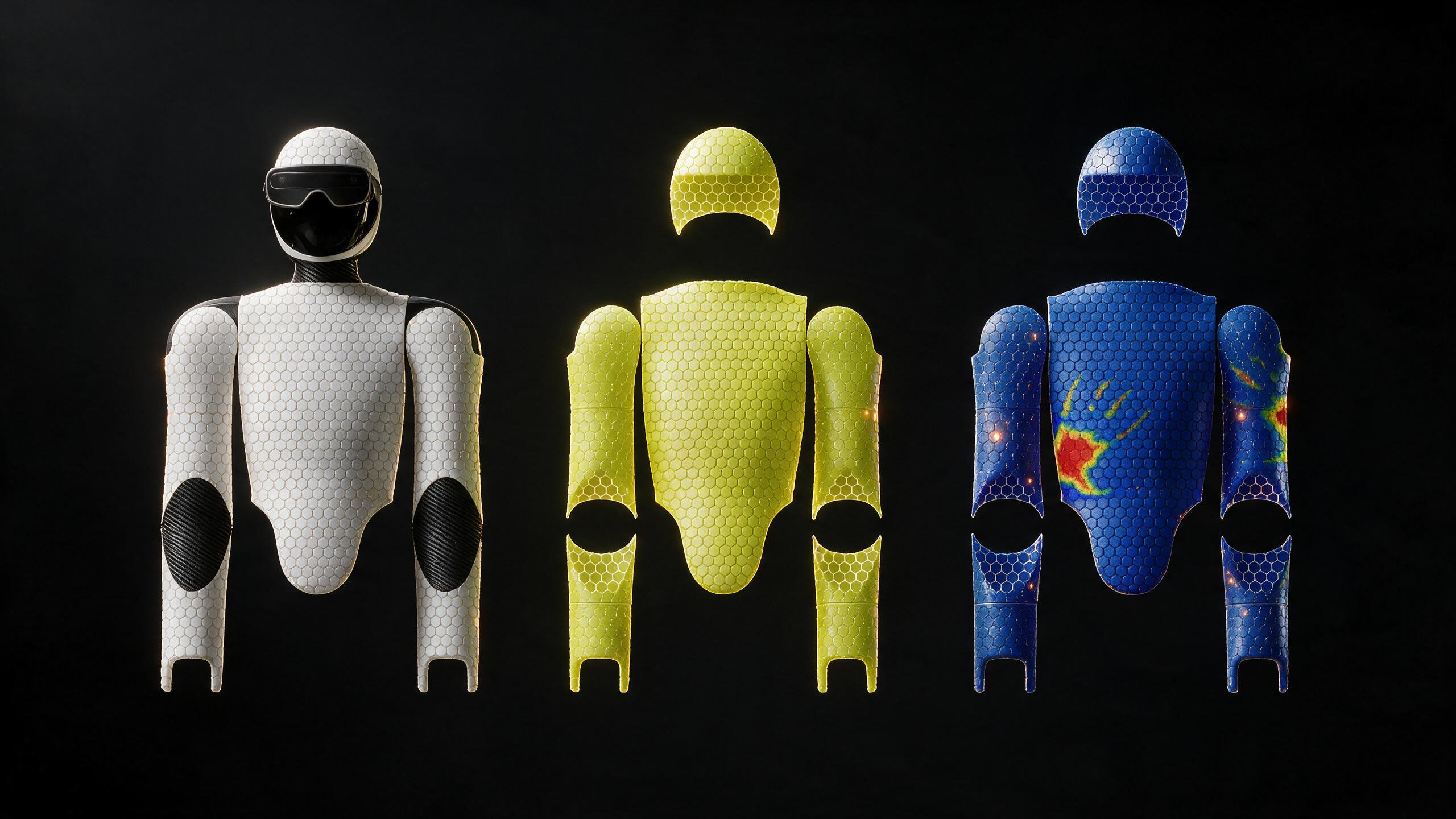
HexSkin extends tactile sensing from local contact points to larger areas of a robot's body, helping a system identify where contact occurs and how it changes. Continuous surface touch refers to coverage and spatial relationships; it does not mean a finite array measures pressure everywhere without error. Coverage, layout, mounting and processing need to be evaluated together.
On arms, torsos and complex surfaces, electronic skin should connect contact regions to the robot's body rather than simply produce a detailed heatmap. Its value lies in usable information for interaction decisions, feedback and task analysis, validated on the intended structure under realistic conditions.
Separate coverage, point count and spatial resolution
Current HexSkin specifications list 1.23 m² of coverage per cluster, 34,300 sensing points, 1.75 mm thickness and a 60 Hz update rate. These describe area, measurement locations, structure and update capability respectively. A large point count does not by itself define local resolution or guarantee identical coverage in every installation.
Local resolution also depends on point spacing, contact shape, force propagation through soft materials and signal processing. Confirm the cluster configuration and conditions behind each specification, and review the array layout and unsensed regions. Critical areas of an arm may require denser coverage than large surfaces with infrequent contact; the task should determine the configuration.
Map discrete channels onto the physical body
Associate every point with a module ID, physical position and local orientation, then transform it into the coordinate frame of the relevant robot link. ROS REP 103 provides a reference for units and frame conventions.[3] A stable mapping keeps contact associated with the correct body region as the arm moves, rather than leaving a list of channels without spatial meaning.
Mark seams, boundaries and uncovered regions explicitly. Heatmap interpolation is a visualization or estimation step, so retain measured points and missing-data indicators. A smooth image does not recover measurements from a seam. Test these locations separately so the display does not hide gaps in coverage.
Validate both mechanics and signals on curved surfaces
Flexible materials conform to curves, but bending, stretch and mounting preload can change baselines and sensitivity. Confirm permitted curvature, stretch and cable routing, and avoid sustained compression or local wrinkles. Protective layers, adhesive and the robot shell should resemble the final structure during evaluation.
Record baselines in three conditions: flat, installed and stationary, and installed during robot motion. Retest known positions and loads. If a joint stretches the skin, check whether the resulting signal can be confused with external contact. Replacement, repair and reattachment also need a repeatable recalibration procedure.
Read update rates in the context of communications
HexSkin lists CAN FD as its interface. CAN in Automation explains that CAN FD has separate arbitration and data phases and supports payloads of up to 64 bytes per frame. Actual throughput depends on bit rates, frame overhead and network configuration.[2] A 60 Hz update specification does not mean any point count and encoding can stream complete raw data over one bus.
For illustration only, 34,300 points at two bytes each, sent as complete frames 60 times a second, would require about 4.116 MB/s of raw payload before timestamps and protocol overhead. This is not HexSkin's actual message format or a throughput promise. It shows why integrators should confirm partitioning, aggregation, compression, event-based reporting and bus count, then measure end-to-end updates with real traffic.
Turn measurements into usable contact events
Controllers often need events such as contact in a region, moving contact or release, rather than every raw channel at once. Begin with zero-offset and temperature checks, then define task-specific thresholds, hysteresis and duration criteria. Retain raw signals for replay and validate thresholds against both no-contact noise and real contact.
For multiaxis measurements, document normal and tangential directions, local coordinates and calibration. NIST's uncertainty framework emphasizes interpreting numbers with their conditions.[4] The brightest heatmap region is not automatically a validated absolute force peak. Flag range limits, saturation and abnormal channels explicitly.
Electronic skin and fingertip touch serve different needs
Fingertip sensing emphasizes fine contact and manipulation; large-area skin emphasizes body coverage and localization. The DIGIT paper studies a compact vision-based tactile sensor for in-hand manipulation.[1] Its sensing principle and configuration differ from HexSkin, so its results should not be reused as product performance or a direct accuracy comparison.
A robot can use different configurations for fine manipulation and body coverage, connected through a shared spatial map. Electronic skin can inform collision and contact detection, but an ordinary tactile channel is not automatically a functional safety system. Collaborative applications require system-level risk assessment and appropriate independent measures, diagnostics and validation.
Plan for maintenance and local faults
Large-area installations face abrasion, contamination and localized damage. Manage modules and calibration by body region, keeping before-and-after mapping records for repairs. Cleaning agents, protective films and replacement surfaces may change material properties; establish compatibility before use. After replacing a patch, check its location and orientation as well as connectivity.
When channels fail, expose the remaining valid coverage and diagnostic state to higher-level software. Whether degraded operation is acceptable depends on the task. Do not silently interpolate across failed areas in a way that suggests full coverage. Measure how local faults affect detection and localization, then use that evidence to plan maintenance.
Accept coverage through real contact tasks
Begin with light contact at known positions, loads from different directions, moving contact across modules and no-contact recordings during robot motion. Measure detection, false alarms, localization error, latency and recovery, including edges, seams and highly curved areas. Save loading conditions, probe geometry and mounting details with results.
Then run whole-robot tasks with simultaneous contacts, communication congestion, disconnected modules and extended operation. Connecting device signals, spatial maps and control logic turns HexSkin's coverage into usable body-contact information—and makes maintenance and replication more manageable.
References
Publications and technical documentation cited in this article. Last checked: 2026-10-19.
- Lambeta et al. — DIGIT (2020) Vision-based tactile sensing for in-hand manipulation; its sensing principle differs from HexSkin.
- CAN in Automation — CAN FD: The Basic Idea Arbitration and data phases, payload and achievable throughput.
- ROS REP 103 — Standard Units of Measure and Coordinate Conventions SI units, right-handed coordinate systems, axes and rotation representations.
- NIST TN 1297 — Classification of Components of Uncertainty Measurement uncertainty and Type A and Type B evaluation.