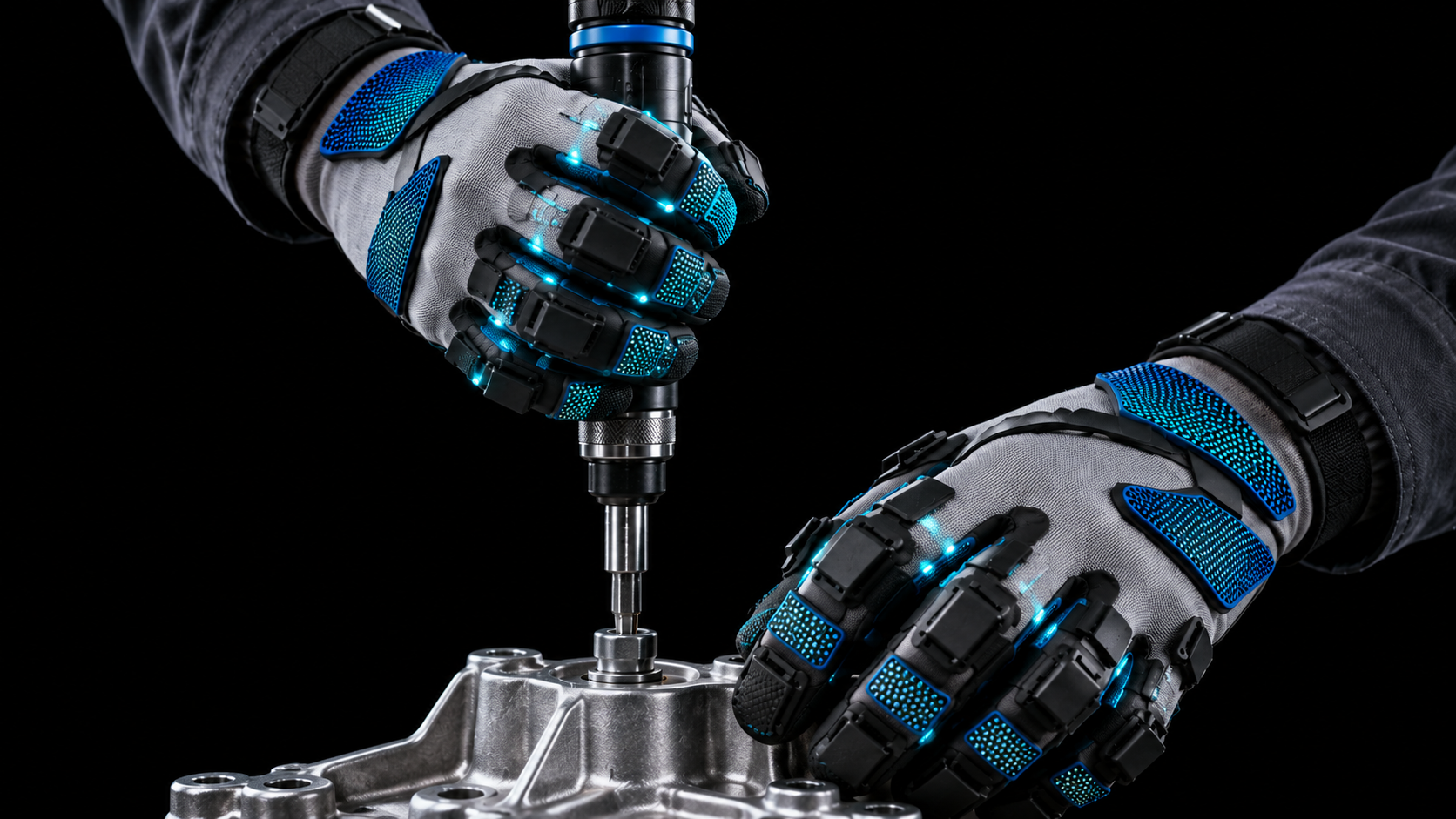
If the task mainly needs visible hand pose and the relationship between hands, objects and the scene, begin by evaluating vision. If it requires continuous finger tracking through occlusion or direct contact measurements, evaluate an appropriately equipped glove or tactile acquisition system. Neither approach wins independently of the task. A hybrid system also needs synchronization and calibration before its channels become complementary.
Common selection mistakes include comparing camera frame rate directly with glove sampling rate, or treating landmark count as evidence of complete contact information. A more useful comparison asks both systems to capture, clean and replay the same representative tasks, then compares the usable results and the work required.
Vision captures context; test it under occlusion
Cameras can observe hands, tools, objects and backgrounds without requiring every operator to wear a device. MediaPipe Hands demonstrates real-time hand skeleton inference from monocular RGB images.[1] Such methods support gesture, pose and visible motion analysis; inferred landmarks do not directly measure contact force.
In fine manipulation, fingertips are frequently hidden by objects, the other hand or tools. Additional cameras can help, but require camera placement, calibration and cross-view association. Include reflective surfaces, low texture, motion blur and lighting changes in evaluation. Interpolated landmarks need validity flags so reconstructed trajectories are not mistaken for observations.
A glove's value depends on what it senses
Wearable sensors reduce some limitations of external camera views, but data gloves are not one technology. Systems may use inertial, bend, optical or other sensing methods. Some report pose only; others also measure touch. Confirm physical measurements, output formats and calibration requirements rather than relying on the product category.
Test fit across hand shapes, finger lengths and fastening conditions. Design experiments for the sensing principle's known limitations, such as inertial drift or sensitivity to the magnetic environment. Hidden fingers do not automatically make glove data accurate, just as occasional landmark failures do not make an entire vision system unsuitable.
Define the boundary of force and touch measurements
Similar finger poses can produce different contact areas and forces. For slip, deformable objects or contact-phase analysis, confirm whether the system has real tactile channels with appropriate ranges, axes, coverage and dynamic response. Force inferred from RGB requires its own model and validation; it should not be presented as direct force measurement.
Glove-mounted touch also depends on surface materials, fit and contact geometry. Document where the load is measured and whether the protective layer changes friction or sensitivity. Following NIST's approach to measurement uncertainty, describe conditions and error sources rather than relying on extra decimal places.[3]
Retargeting matters more than capturing hand shape
Both cameras and gloves need to map human movement into the target robot's action space. A full hand skeleton may not be the most useful representation for a two-finger gripper; a multifinger hand may need fingertip constraints and coordinated joints. Start with the commands the robot will receive, then design acquisition fields and retargeting around them.
The Universal Manipulation Interface (UMI) study collects demonstrations with a handheld gripper and emphasizes relative trajectories and latency matching at deployment.[2] It is not a direct glove-versus-vision comparison. Its broader lesson is that the demonstration interface needs to fit the deployment interface. A natural human movement is useful only if it can map reliably to the robot.
Compare representative workflows
Include unobstructed grasping, crossed hands, small tools, rapid rotation and extended repetitive sessions. Fix objects, instructions and success criteria. Record the complete process from preparation to usable data, and define anomaly rules in advance so the scoring does not change after results are seen.
Compare joint or fingertip error against an independent reference, continuous valid tracking time and recovery after occlusion. Measure calibration time per operator, repeat captures and cleaning effort. Where touch matters, compare complete contact events and their timing relative to motion. Keep raw records and test conditions for every metric.
Give hybrid systems clear responsibilities
A testable arrangement uses cameras for objects and scene context, a glove for hand motion, and tactile channels for contact changes. Before fusion, establish clock relationships, coordinate transforms, device IDs and calibration versions. If cameras provide wrist position, define when that estimate is valid and when it should be marked missing.
Additional sensors increase bandwidth, storage and exception-handling complexity. Establish a single-system baseline and add channels incrementally, checking which failures they actually reduce. More modalities can introduce problems if timing is wrong or wearable hardware changes the action being demonstrated.
Two easily missed questions for a pilot
Does the glove change natural manipulation? Check rather than assume. Thickness, friction, cables and fit can affect small-object handling and bimanual work. Compare the same tasks before and after putting on the device, recording completion time, failure types and operator burden. If the task does not permit wearables, vision may be the better primary channel.
Does a demonstration video establish long-term suitability? Usually not. Short demos rarely cover repeated fitting, operator changes, recalibration and data cleaning. A pilot should follow the real workflow and verify that exported data preserves timing, missingness and operator identity. Include manual correction costs in the comparison and improve the workflow before expanding collection.
Measure the cost of usable data
Purchase price is only part of the cost. Space, cameras, fitting, cleaning, calibration, operator training, recapture, post-processing and maintenance all affect the cost per hour of usable demonstration. Measure labor from preparation to training-ready data for a fixed task, keeping failure reasons alongside throughput.
When evaluating Ensuring Magic Glove, begin with a small trial covering fit, synchronized motion and touch, export and integration with the target hand. Validate a task set before expanding objects, operators and environments. Reproducible data quality and delivery effort provide a clearer basis for selection and later acceptance criteria.
References
Publications and technical documentation cited in this article. Last checked: 2026-10-19.
- Zhang et al. — MediaPipe Hands (2020) Real-time hand skeleton inference from monocular RGB images.
- Chi et al. — Universal Manipulation Interface (2024) Handheld gripper demonstrations, relative trajectories and deployment latency matching; not a glove comparison study.
- NIST TN 1297 — Classification of Components of Uncertainty Measurement uncertainty and Type A and Type B evaluation.